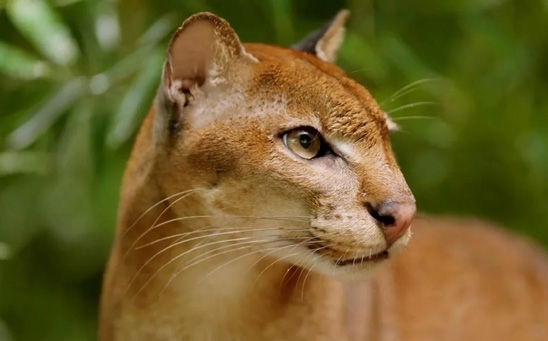
Over the past 16 years, Mugerwa has dedicated his career to “Africa’s least known, least understood, least studied big cat.” Found in dense tropical forests across Central and Western Africa, the species is so elusive that the last IUCN assessment — over a decade old — has no population estimates, and in all his years of fieldwork, Mugerwa has only managed a fleeting glimpse of the African golden cat three times with his own eyes. The International Union for Conservation of Nature (IUCN), the world’s largest environmental network of government and society organizations, tracks threatened wildlife. “They’re really, really difficult to see in the wild,” says Mugerwa, who won the Indianapolis Prize Emerging Conservationist Award earlier this year for his work on the species. But, realizing that accurately counting the big cats was the first step to protecting them, he set out to conduct the first population census across the species’ range, expected to publish next year. In 2019, Mugerwa founded the African Golden Cat Conservation Alliance (AGCCA), a network of 46 conservationists across 19 countries. Together, they launched a standardized camera trap survey across the cat’s suspected range, supported by funding from the National Geographic Society. But manually reviewing thousands of images from 30 sites across 19 countries, the largest camera trap grid for any African wildlife species, was very difficult. At the same time, U.S.-headquartered nonprofit Panthera, another of Mugerwa’s collaborators, was developing an AI algorithm that could quickly sort the images and identify individual cats based on their unique coat patterns, similar to how tiger stripes are used like fingerprints. Otherwise, distinguishing individual cats would be nearly impossible due to their small size and subtle markings. Preliminary data suggests the species exists at low densities — even in protected habitats. In Uganda and Gabon, for example, surveys found just 16 individuals per 100 square kilometers. The surveys have also revealed the impact of poaching: in areas with hunting restrictions, Mugerwa says cat populations were up to 50% higher, with wider distribution. The study has also observed that while the cats are active both day and night, many are strictly nocturnal — likely to avoid human activity during the day. Early in his research, Mugerwa realized that hunting was the cat’s primary threat. In East Africa, where Mugerwa is based, the African golden cat is rarely the target of hunters. But bushmeat snares, set for pigs and antelopes, are indiscriminate, often catching other species unintentionally. In 2019, Mugerwa received reports of 80 golden cats caught in snares in three Ugandan forests, 88% of which were accidental. To combat the cat’s biggest threat, Mugerwa went directly to the residents, creating Embaka: a community-based anti-poaching conservation project focused on the African golden cat. Working with over 8,000 families across the cat’s range, the project engages local communities — many of whom are former poachers — to deploy camera traps and report sightings. 過(guò)去16年間,穆格瓦將職業(yè)生涯奉獻(xiàn)給了“非洲認(rèn)知度最低、研究最匱乏的大型貓科動(dòng)物”。非洲金貓棲息于中西部非洲茂密熱帶雨林,行蹤詭秘。上次世界自然保護(hù)聯(lián)盟評(píng)估距今已逾十年,而且未能統(tǒng)計(jì)其種群數(shù)量;穆格瓦在多年野外考察中也僅親眼瞥見(jiàn)過(guò)三次非洲金貓的身影。 作為全球規(guī)模最大的政府與社會(huì)組織環(huán)保網(wǎng)絡(luò),世界自然保護(hù)聯(lián)盟持續(xù)追蹤瀕危野生動(dòng)物動(dòng)態(tài)。穆格瓦因?qū)Ψ侵藿鹭埖难芯坑诮衲瓿鯓s獲印第安納波利斯保護(hù)獎(jiǎng)新銳保育學(xué)者稱號(hào)。他坦言:“在 野外極難觀測(cè)到它們的存在。” 意識(shí)到精準(zhǔn)統(tǒng)計(jì)是保護(hù)該物種的第一步,穆格瓦啟動(dòng)了金貓分布區(qū)的首次全域種群普查,預(yù)計(jì)結(jié)果將于明年公布。2019年,他創(chuàng)立了非洲金貓保護(hù)聯(lián)盟,匯聚了19個(gè)國(guó)家的46位保育專家。 在國(guó)家地理學(xué)會(huì)資助下,他們?cè)诮鹭堃伤苹顒?dòng)區(qū)域布設(shè)了標(biāo)準(zhǔn)化相機(jī)監(jiān)測(cè)網(wǎng)絡(luò)。這項(xiàng)覆蓋19國(guó)30個(gè)監(jiān)測(cè)點(diǎn)的項(xiàng)目構(gòu)成了非洲野生動(dòng)物研究中規(guī)模最大的相機(jī)矩陣,但人工處理海量圖像困難重重。 彼時(shí),穆格瓦的另一合作方 —— 總部位于美國(guó)的非營(yíng)利組織Panthera正在開(kāi)發(fā)人工智能算法。該技術(shù)能快速篩選圖像,并依據(jù)每只金貓獨(dú)特的毛皮斑紋識(shí)別個(gè)體,原理類似于通過(guò)虎紋進(jìn)行個(gè)體鑒定。鑒于金貓?bào)w型較小且斑紋細(xì)微,傳統(tǒng)識(shí)別方法幾乎無(wú)法實(shí)現(xiàn)個(gè)體區(qū)分。 初步數(shù)據(jù)顯示該物種分布密度極低 —— 即使在保護(hù)區(qū)內(nèi)也如此。例如在烏干達(dá)和加蓬的監(jiān)測(cè)中,每100平方公里僅發(fā)現(xiàn)16只個(gè)體。調(diào)查還揭示了盜獵的影響:穆格瓦指出,在禁獵區(qū)金貓種群數(shù)量高出50%且分布更廣。研究還發(fā)現(xiàn),雖然金貓晝夜均活動(dòng),但多數(shù)夜間活動(dòng) —— 可能為了避開(kāi)白天的人類活動(dòng)。 研究初期穆格瓦便意識(shí)到盜獵是金貓的首要威脅。在他工作的東非地區(qū),非洲金貓雖非主要盜獵目標(biāo),但用于捕捉野豬和羚羊的陷阱往往無(wú)差別捕獲其他動(dòng)物。2019年,僅烏干達(dá)三處森林就上報(bào)了80起金貓誤入陷阱事件,其中88%屬意外捕獲。為應(yīng)對(duì)這一最大威脅,穆格瓦直接深入社區(qū)創(chuàng)建了“恩巴卡計(jì)劃”——以非洲金貓為核心的社區(qū)反盜獵保護(hù)項(xiàng)目。該項(xiàng)目覆蓋金貓分布區(qū)內(nèi)8000多個(gè)家庭,動(dòng)員當(dāng)?shù)厣鐓^(qū)(包括許多前盜獵者)布設(shè)相機(jī)并上報(bào)觀測(cè)記錄。(Translated by DeepSeek) | 