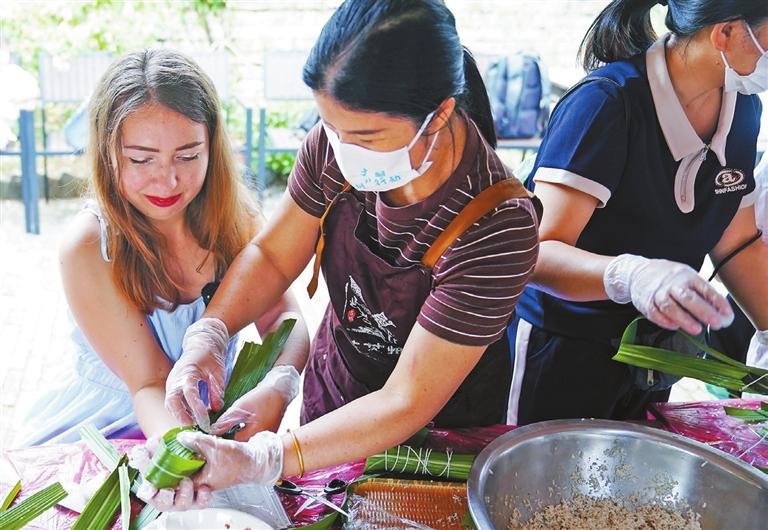
Chen Siqi vankochensq@163.com SEA urchin meat, hidden within a black, thorny, round shell, is often served as a delicacy with fried rice. But have you ever tried a zongzi filled with sea urchin? During Shenzhen International Marine Week 2025, a “Taste the Ocean” series event held at Dapeng Fortress on Saturday and Sunday gave expats and local residents the chance to taste this special dish and learn how to make it. Around 200 participants took part in the event. This unique delicacy is a form of intangible cultural heritage that originates from Nan’ao Village in Shenzhen’s Dapeng New Area. After listening to a historical overview of Dapeng Fortress — first built in 1394 during the Ming Dynasty (1368-1644) as a vital coastal defense stronghold and home to more than 10 military generals and their families — Tahiry Rakotomamonjy, a resident from Madagascar who has lived in Shenzhen for just five months, tried making the delicacy Saturday. “This is my first time hearing about zongzi. I will share this experience with my children,” said Rakotomamonjy. “It is very interesting to use what I thought were banana leaves to wrap food.” The leaves Rakotomamonjy mentioned were actually locally grown Mangye (芒葉), with the scientific name Thysanolaena latifolia. An instructor on-site, surnamed Zhong, explained that the leaves have a natural, faint scent that enhances the zongzi’s flavor. Unlike traditional triangular zongzi, sea urchin zongzi are usually rectangular. Zhong taught the participants how to wrap them: first, fold the leaves; then fill it with sea urchin, savory meat, peanuts, dried shrimp, and sticky rice; and finally, wrap it all up with a string. Zhong, who is also a Dapeng resident, told Shenzhen Daily that the best time to eat sea urchin zongzi is around the Dragon Boat Festival because the sea urchins harvested between May and July are the plumpest. “There is a saying — ‘Live off the mountain when you are on the mountain. Live off the sea when you are by the sea.’ As we live by the seaside, we are able to enjoy abundant seafood resources,” Zhong added. | 