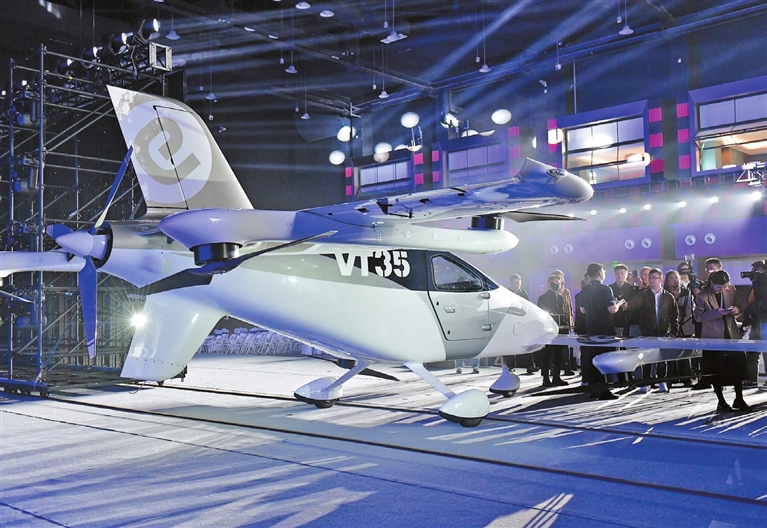
EHANG Holdings Ltd. on Monday unveiled its new?generation long?range pilotless electric vertical takeoff and landing (eVTOL) aircraft, the VT35. Built on the company’s earlier VT30 prototype, the VT35 is an upgraded lift?and?cruise design aimed at medium? to long?range missions including intercity, cross?sea and cross?mountain routes. The two?seat, tandem?wing aircraft combines autonomous flight capability with electric propulsion to target point?to?point low?altitude mobility between urban and intercity corridors. EHang announced a domestic market price of 6.5 million yuan (US$911,378) for the VT35 standard version. After comprehensive preliminary design validation and R&D debugging, the aircraft has completed transition flight testing, a key step toward commercial readiness. The VT35 uses eight distributed lift propellers for vertical takeoff and landing, then shifts to a pusher propeller and fixed wings for efficient cruise. It has a maximum design range of roughly 200 kilometers at full load and is notably compact for its class — about 8 meters in length and wingspan, 3 meters in height, with a maximum takeoff weight of 950 kg. EHang says the smaller footprint reduces ground operational risk and improves cost efficiency. The VT35 is compatible with existing EH216?S vertiports and can operate from a variety of urban takeoff and landing sites, including parks, rooftops and parking lots, enabling closer point?to?point service between city centers. Leveraging EHang’s autonomous flight systems, fleet management, full?redundancy architecture and command?and?control platforms, the aircraft is designed for automated, coordinated fleet operations along pre?set routes. Safety features include obstacle detection and avoidance. In March, the Civil Aviation Administration of China accepted EHang’s type certification application for the VT35; the model is currently undergoing airworthiness certification while internal testing and experimental flights continue. EHang plans to leverage the VT35 platform for continued innovation, such as developing a tilt-rotor model to expand into more diverse applications. (SD News) | 