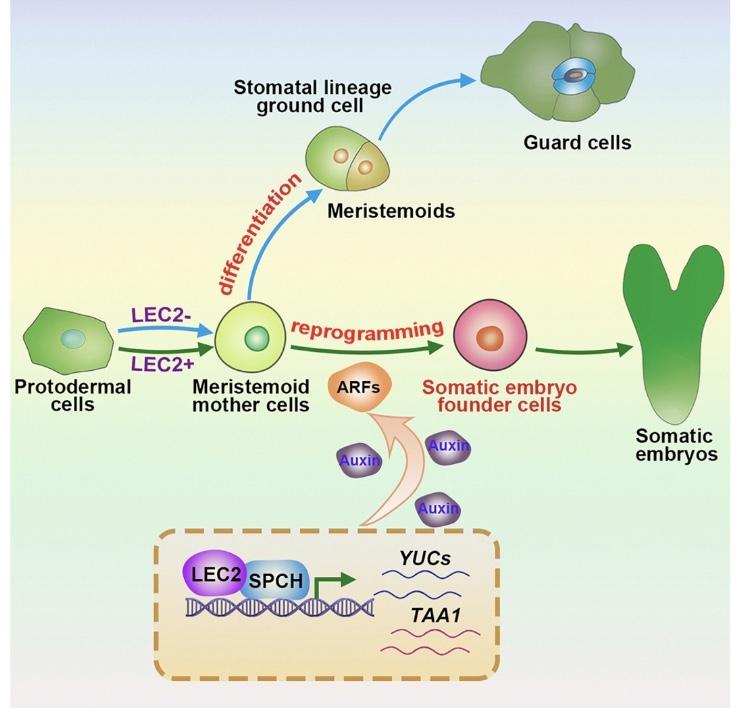
CHINESE scientists have, for the first time, mapped how a single somatic plant cell reprograms into a totipotent stem cell and develops into a complete plant — a breakthrough that resolves a century?old question about plant cell totipotency and could enable faster cloning of elite crops and better conservation of rare germplasm. The findings were published online in Cell. Embryos normally arise from a zygote, a totipotent cell formed by gamete fusion. The idea that differentiated plant cells can dedifferentiate into totipotent cells was proposed in 1902, but the underlying molecular mechanism remained unknown and widely debated. A team led by Zhang Xiansheng at Shandong Agricultural University began this line of research in 2005 using Arabidopsis thaliana as a model. Over two decades they developed an experimental system demonstrating that a single somatic cell can directly initiate embryogenesis, and showed that accumulation of auxin acts as a key trigger for activating totipotency. Using scanning electron microscopy, single?nucleus RNA sequencing, and spatial laser?capture microdissection combined with RNA sequencing, the researchers captured the full sequence of cellular changes during reprogramming, providing direct evidence for a single?cell origin of somatic embryogenesis. At the molecular level they identified two required factors — a stomatal precursor cell gene, SPCH, and inducible overexpression of the embryogenic regulator LEC2 — that together form a “two?key” molecular switch. During the critical transition from differentiated cell to totipotent stem cell the team observed extensive chromatin remodeling and progressive activation of previously silent genes, marking a branching point in the cell trajectory that leads to totipotency. Experts say the study is the first comprehensive explanation of how a single somatic cell is reprogrammed and regenerated into a whole plant. Zhong Kang, a plant physiologist and academician at the Chinese Academy of Sciences, said the work both deepens fundamental understanding and offers a path to overcome the “regeneration bottleneck” in agricultural biotechnology. According to Shandong Agricultural University, parallel experiments are already underway in wheat, maize and soybean. The researchers say the ability to precisely control cell totipotency could shorten breeding cycles through rapid cloning of superior varieties, enable precision trait improvement, and provide new tools for germplasm conservation and plant synthetic biology.(SD-Agencies) | 