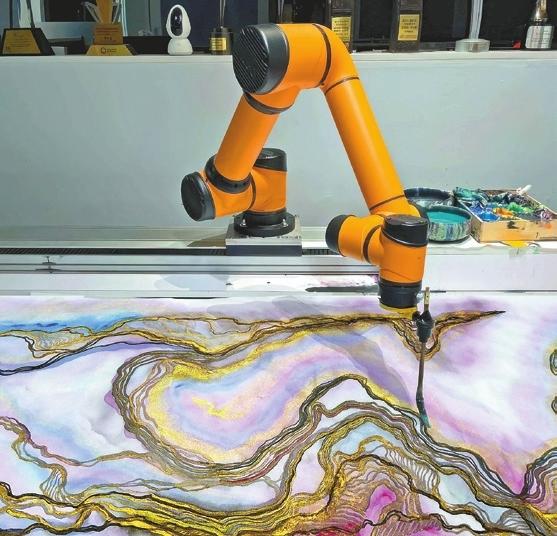
In 2018, Christie’s held its first auction for a work of art produced by artificial intelligence (AI), which sold for US$432,500. But Hong Kong-based cross-media artist Victor Wong didn’t think the painting — which looks like a blurry oil painting of a man — was anything that revolutionary. “It totally mimics human work, it wasn’t something different,” he said. So the creative — who has a degree in electrical engineering and whose work spans movie special effects, art tech installations, and sculpture, among other art forms — decided to make something unique. His creation, AI Gemini, is an AI-driven robot that creates traditional Chinese landscape paintings — the “first-ever artificial intelligence ink artist in the world,” according to 3812 Gallery, which represents Wong. With no relation to Google’s generative AI chatbot of the same name, AI Gemini uses a robotic arm, purchased online and re-programmed, with an attached paintbrush. An algorithm interprets data sets of Wong’s choosing, directing the robotic arm to paint mountain contours to form a landscape on Xuan paper, a thin rice paper traditionally used for painting. The application of colors is based on deep learning and training in traditional ink landscape painting, and the amount of water used depends on changes in humidity, Wong explains. It takes about eight to 10 hours to produce a painting that’s one meter tall and wide. Since Wong launched AI Gemini, he’s held exhibitions in Hong Kong, Shanghai, Taipei, and London. He says his paintings have sold for around US$20,000 to individual collectors, and he’s worked on projects for companies like Hong Kong’s flagship airline Cathay Pacific. Ink landscape paintings date back thousands of years in China. Yet Wong says that by combining the ideas of humans with the capabilities of technology, he hopes to create “something that hasn’t been seen before.” The use of AI to create artwork is controversial. Earlier this year, more than 6,500 people signed an?open letter?calling on Christie’s New York to cancel a sale?dedicated solely to art created with the technology — the first of its kind for a major auction house. The sale, which went ahead, brought in US$729,000. Critics say that AI art lacks originality and artists complain that it’s based on copyrighted images. Wong doesn’t directly use AI-generated images. Instead of “training AI Gemini to copy the masters’ artwork,” Wong says he wrote an algorithm to mimic how the master’s work. He says that the paintings he and AI Gemini create are original but adds that people attending his exhibitions will still sometimes exclaim, “It’s not art!” “AI has become a part of life, and people still cannot really accept it, especially when it comes to art,” says Wong. But, he adds: “You cannot escape AI.” 2018年,佳士得拍賣行首次上拍人工智能創作的藝術品,該作品最終以43.25萬美元成交。但香港跨媒體藝術家黃宏達認為,這幅模糊的男性肖像油畫并無革命性突破:“它完全在模仿人類作品,毫無新意”。 這位擁有電子工程學位、涉足電影特效、科技藝術裝置及雕塑等多領域的創意人,決定打造真正獨特的作品。他創造的 “AI雙子星”是一個能創作傳統山水畫的AI機器人,其代理畫廊3812稱其為“全球首位人工智能水墨藝術家”。 與谷歌的同名AI聊天機器人無關,這款AI雙子星由網購的機械臂改造而成,通過算法解析黃宏達精選的數據集,指揮加裝毛筆的機械臂在宣紙上勾勒山巒輪廓。黃宏達解釋,墨色運用基于深度學習與傳統水墨畫訓練,用水量則隨濕度變化調整,每幅一米見方的作品需耗時8至10小時。 自推出以來,AI雙子星作品已在香港、上海、臺北和倫敦展出。黃宏達透露作品以約2萬美元單價被私人藏家收藏,并為國泰航空等企業創作項目。 盡管水墨山水畫在中國有數千年歷史,但黃宏達希望通過人機協作創造“前所未見之物”。AI藝術引發巨大爭議 —— 今年初6500人聯署要求佳士得取消紐約首場AI藝術專場拍賣(最終成交72.9萬美元)。批評者認為AI藝術缺乏原創性,藝術家指責其剽竊受版權保護的圖像。 黃宏達并未直接使用AI生成圖像,而是編寫算法模擬大師筆法。他強調其作品具有原創性,但展覽中仍有人質疑“這不是藝術!”。 對此他表示:“AI已成為生活的一部分,但人們尤其難以接受它涉足藝術領域。然而,我們已無處可逃。”(Translated by DeepSeek) | 